Tesla's Q1 Profit Rebounds as Elon Musk Teases the New Roadster: What It Means for Tesla's Future
Tesla's Latest Earnings Were About More Than Quarterly Numbers
Quarterly earnings reports are often viewed as scorecards.
Revenue.
Profit.
Margins.
Cash flow.
These figures help investors evaluate how a company performed over the previous three months.
Yet for companies like Tesla, earnings calls often serve another purpose.
They provide insight into where management believes the company is heading.
Following Tesla's latest first-quarter results, one announcement generated almost as much discussion as the financial figures themselves.
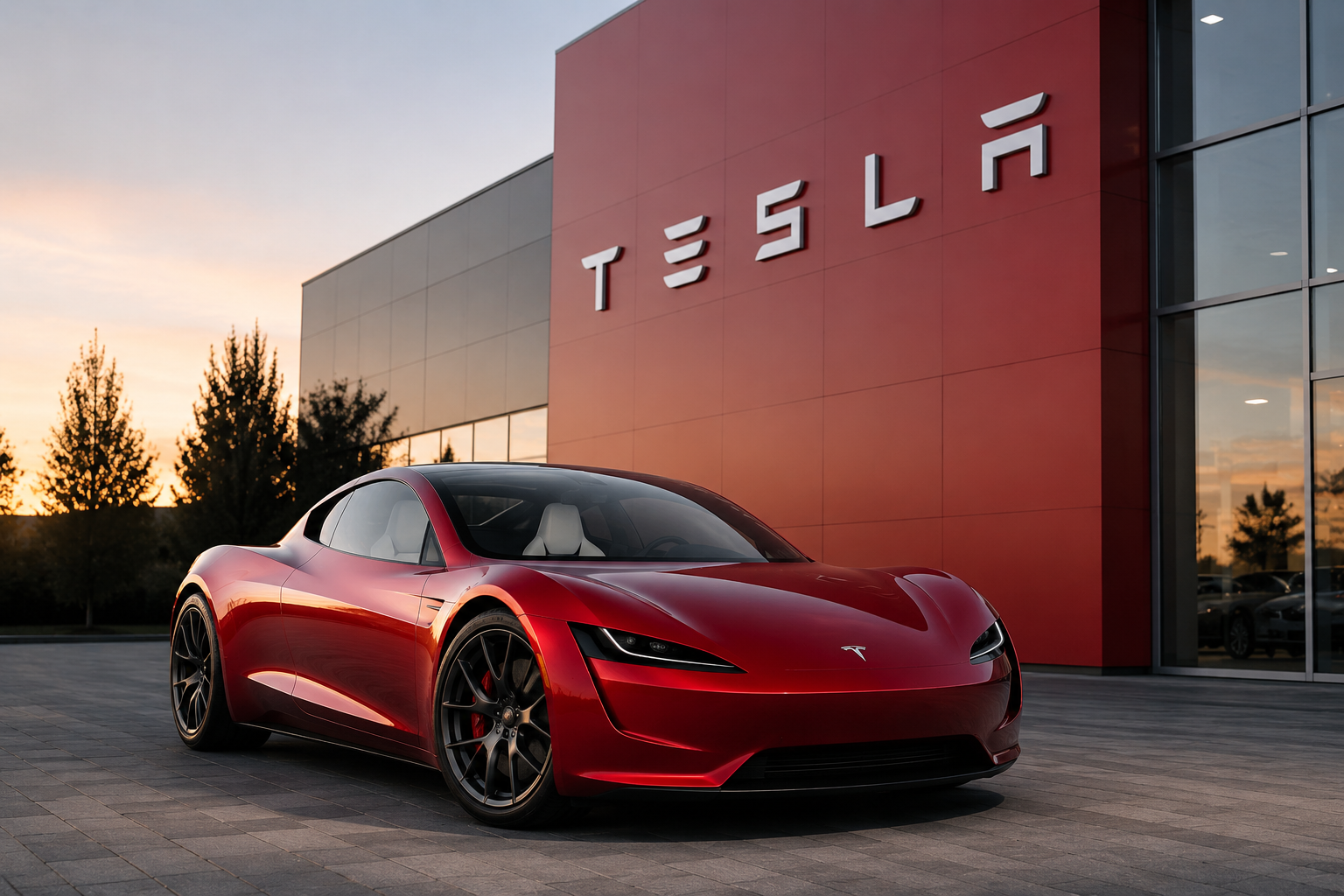
Elon Musk once again highlighted the next-generation Tesla Roadster.
At first glance, this seemed surprising.
The Roadster is expected to sell in relatively small numbers compared with high-volume models such as the Model 3 and Model Y.
From a purely financial perspective, it is unlikely to become Tesla's largest revenue contributor.
So why introduce it during an earnings discussion largely focused on profitability and business performance?
The answer lies in understanding the role that flagship products play in shaping both investor expectations and brand perception.
Understanding Tesla's First-Quarter Financial Performance
Tesla's first-quarter results showed signs of improving profitability compared with earlier periods, although the company's financial performance continued to reflect a challenging global automotive market.
Several factors influenced quarterly results, including:
- Vehicle deliveries across multiple regions.
- Continued investment in artificial intelligence and autonomous driving.
- Growth in Tesla Energy.
- Ongoing manufacturing efficiency improvements.
- Cost management initiatives.
Rather than evaluating one metric in isolation, professional investors typically examine how these factors interact.
For example, stronger profitability carries greater significance when achieved alongside continued investment in future technologies.
Likewise, improving operational efficiency may provide a stronger indication of long-term competitiveness than temporary fluctuations in quarterly margins.
Tesla's financial reports increasingly reflect a company balancing two priorities:
- Maintaining healthy financial performance today.
- Investing aggressively for tomorrow.
That balance has become one of the defining characteristics of Tesla's business strategy.
Financial Results Tell Us About the Past
One important principle of investing is recognizing what financial statements can—and cannot—tell us.
Income statements describe what has already happened.
Balance sheets summarize current financial resources.
Cash flow statements reveal how capital has been generated and deployed.
All of these metrics are essential.
But they remain backward-looking.
Markets, however, are forward-looking.
Investors continually evaluate whether today's decisions are likely to improve tomorrow's earnings power.
This helps explain why product announcements sometimes influence market sentiment almost as much as quarterly profits.
A company's future growth opportunities often matter as much as its most recent financial performance.
Tesla illustrates this dynamic particularly well.
While quarterly profitability remains closely watched, many investors also evaluate progress in artificial intelligence, autonomous driving, robotics, battery technology, and future vehicle platforms.
These initiatives may shape Tesla's long-term value far more than any single quarter's earnings.
Why Mention the Roadster During an Earnings Update?
At first glance, discussing the Roadster during an earnings presentation may appear unrelated to quarterly financial performance.
In reality, the timing is understandable.
The Roadster represents something larger than a single product.
It symbolizes Tesla's continuing commitment to engineering leadership.
Throughout automotive history, many manufacturers have introduced limited-production flagship vehicles that serve purposes beyond direct profitability.
Examples include:
- Ferrari's halo supercars.
- Porsche's 918 Spyder.
- Mercedes-AMG ONE.
- McLaren P1.
These vehicles rarely become the highest-volume models.
Instead, they demonstrate technological capability, strengthen brand identity, and attract global attention.
Tesla's Roadster occupies a similar position.
Its significance extends beyond expected sales volume.
It communicates what Tesla believes its engineering teams can achieve.
That message can influence consumer confidence, investor sentiment, and overall brand value.
The Roadster Is a Strategic Product, Not a Volume Product
From a business perspective, products do not all serve the same purpose.
Some maximize sales volume.
Others maximize profitability.
Still others strengthen a company's reputation.
The Roadster belongs primarily to the third category.
It acts as a technological showcase.
Features expected from the next-generation Roadster—including exceptional acceleration, advanced engineering, and innovative performance technologies—reinforce Tesla's reputation as an innovation-driven company.
Even customers who never intend to purchase a Roadster may develop stronger confidence in Tesla's broader product lineup because of what the flagship vehicle represents.
This phenomenon has existed throughout the automotive industry for decades.
A successful halo product often enhances the perceived value of an entire brand.
Why Halo Products Matter More Than Their Sales Numbers
One of the biggest misconceptions in the automotive industry is that every vehicle must become a best seller to be considered successful.
History suggests otherwise.
Many of the world's most influential automobiles were never produced in large quantities.
Instead, they served a different purpose.
They demonstrated technological leadership.
They inspired future product development.
They elevated the brand's reputation.
Automakers often refer to these vehicles as halo products because their influence extends across the entire product lineup.
A halo product creates excitement that benefits every model beneath it.
Consumers who admire a flagship sports car may ultimately purchase a more affordable SUV or sedan from the same manufacturer.
In that sense, the flagship vehicle helps sell products far beyond its own production volume.
Tesla's Roadster fits naturally into this strategy.
Innovation Creates Confidence Across the Entire Product Line
The Roadster is unlikely to generate revenue comparable to the Model Y.
Nor is it expected to account for a significant percentage of Tesla's annual deliveries.
Its importance lies elsewhere.
A company capable of engineering one of the world's most advanced performance EVs sends a broader message about its technological capabilities.
Customers often assume that innovations developed for flagship vehicles will eventually influence mainstream products.
That expectation is not unique to Tesla.
Throughout automotive history, technologies such as carbon-fiber construction, advanced battery management, aerodynamic improvements, and high-performance electric motors often appeared first in premium vehicles before becoming more widely available.
If the next-generation Roadster introduces meaningful engineering advances, some of those technologies could gradually benefit future versions of the Model S, Model 3, Model Y, Cybertruck, or entirely new platforms.
Viewed from this perspective, the Roadster functions as a research and development showcase as much as a commercial product.
Brand Value Cannot Always Be Measured on an Income Statement
Financial reports capture revenue, expenses, assets, and cash flow.
They do not directly measure brand aspiration.
Yet brand value influences nearly every purchasing decision.
Consumers rarely choose products based solely on technical specifications.
They also consider trust, innovation, reliability, and emotional appeal.
Tesla has built much of its reputation around pushing technological boundaries.
The original Roadster demonstrated that electric vehicles could deliver sports-car performance at a time when many people still viewed EVs as slow and impractical.
Today's Roadster carries a different responsibility.
Rather than proving that electric performance is possible, it reinforces Tesla's image as a company that continues pursuing ambitious engineering goals even as it has grown into one of the world's largest EV manufacturers.
That reputation can strengthen demand across the company's broader portfolio.
A Flagship Product Influences Investor Psychology
Consumers are not the only audience paying attention.
Investors also interpret flagship products differently from high-volume vehicles.
A new mass-market model primarily affects production forecasts and revenue projections.
A halo product influences perceptions of technological leadership.
When Elon Musk discusses the Roadster during an earnings update, investors often interpret the announcement as a signal rather than a sales forecast.
The signal is that Tesla intends to remain at the forefront of automotive innovation.
Whether every timeline unfolds exactly as planned is a separate question.
The strategic message itself still carries weight.
Capital markets often respond not only to current earnings but also to management's confidence in the future direction of the business.
Tesla's Product Portfolio Is Becoming Increasingly Specialized
Another reason the Roadster matters is that Tesla's product lineup has become more strategically diversified.
Each major product now serves a distinct role.
| Product | Primary Strategic Role |
|---|---|
| Model 3 | Expand global EV adoption through affordability and efficiency |
| Model Y | Generate volume, profitability, and ecosystem growth |
| Model S | Showcase premium technology and long-range capability |
| Model X | Demonstrate engineering innovation in the luxury SUV segment |
| Cybertruck | Introduce Tesla into the pickup market while reinforcing the brand's unconventional identity |
| Roadster | Act as Tesla's engineering flagship and strengthen brand prestige |
| Robotaxi Platform | Lay the foundation for autonomous mobility services |
| Tesla Energy | Diversify revenue beyond automotive markets |
This layered strategy reduces dependence on any single product.
It also allows Tesla to pursue different customer segments without requiring every vehicle to achieve identical commercial objectives.
The Roadster Supports Tesla's Long-Term Innovation Narrative
Public companies compete not only through products but also through narratives.
Investors seek evidence that management continues investing in future growth rather than focusing exclusively on short-term financial performance.
The Roadster contributes to that narrative.
It reminds the market that Tesla's ambitions extend beyond manufacturing practical electric vehicles.
The company continues exploring higher-performance battery systems, advanced vehicle engineering, and technologies that may eventually influence its broader product portfolio.
Even if Roadster production remains relatively limited, its symbolic value can be substantial.
It reinforces Tesla's identity as an engineering company rather than simply an automobile manufacturer.
Looking Beyond Quarterly Earnings
Quarterly profits are important.
They demonstrate operational discipline.
Healthy cash flow supports continued investment.
Strong margins improve financial resilience.
Yet investors also recognize that today's earnings cannot fully explain tomorrow's opportunities.
Tesla's long-term value will depend on its ability to transform engineering breakthroughs into scalable businesses.
Products like the Roadster contribute to that process by pushing technological boundaries, attracting talent, and strengthening the company's innovation culture.
Viewed through this lens, discussing the Roadster during an earnings call becomes far more understandable.
The conversation was not simply about one future sports car.
It was about reinforcing Tesla's long-term identity as a company driven by engineering ambition.
Tesla's Future Depends on Balance, Not Just Breakthroughs
When people think about Tesla's future, they often focus on the next major innovation.
Robotaxi.
Artificial intelligence.
Humanoid robots.
The next-generation Roadster.
Each of these projects attracts significant attention because they represent possibilities beyond Tesla's current business.
However, sustainable growth rarely comes from breakthrough products alone.
It comes from balancing innovation with execution.
Tesla's long-term success depends on continuing to sell high-volume vehicles like the Model 3 and Model Y while simultaneously investing in technologies that could define the next decade of transportation and energy.
The Roadster is part of that balance.
Its role is not to replace Tesla's core business, but to reinforce the company's reputation for engineering excellence while inspiring future technological development.
Engineering Leadership Requires Long-Term Investment
Developing a flagship performance vehicle is rarely the fastest way to maximize quarterly profits.
Research and development costs can be substantial.
Production volumes are typically limited.
Engineering challenges are often greater than those associated with mass-market vehicles.
Yet history shows that many automotive innovations first appeared in flagship models before becoming commercially viable at larger scale.
Advanced materials.
High-performance battery systems.
Improved thermal management.
Aerodynamic optimization.
Sophisticated vehicle software.
These technologies often begin as premium engineering projects before gradually benefiting mainstream products.
If Tesla applies this approach successfully, the Roadster could influence future generations of vehicles even if its own production numbers remain relatively modest.
Its value would therefore extend beyond direct sales.
Expectations Must Be Matched by Execution
Excitement alone does not create long-term business value.
Tesla has demonstrated an ability to introduce ambitious concepts that reshape industry expectations.
At the same time, some high-profile projects have experienced delays as engineering complexity increased.
The Roadster itself has undergone multiple revisions to its expected launch timeline.
This context is important.
Investors and consumers should distinguish between product vision and commercial execution.
Announcing an innovative vehicle generates attention.
Delivering it at scale with consistent quality is what ultimately determines its commercial success.
Tesla's credibility will continue to depend not only on ambitious announcements but also on meeting realistic production milestones.
The Roadster Reflects Tesla's Broader Identity
The significance of the Roadster extends beyond specifications such as acceleration or top speed.
It reflects how Tesla wants to be perceived.
Rather than competing only on price or production volume, Tesla continues positioning itself as a company driven by engineering ambition.
That identity influences several aspects of the business:
- Customer confidence.
- Investor perception.
- Recruitment of engineering talent.
- Brand differentiation.
- Long-term innovation culture.
Strong brands are built through consistent technological leadership as much as through successful commercial products.
The Roadster reinforces that message.
What Investors Should Watch Going Forward
Rather than focusing solely on whether the Roadster reaches production on a specific date, investors may benefit from monitoring broader indicators of Tesla's progress.
1. Product Development Milestones
Does Tesla continue demonstrating measurable progress in vehicle engineering, battery technology, and performance systems?
Consistent technical advancement often matters more than headline announcements.
2. Manufacturing Readiness
Can Tesla integrate new technologies into production efficiently while maintaining quality and cost discipline?
Manufacturing execution has historically been one of the company's competitive strengths.
3. Financial Discipline
Is Tesla able to continue investing in long-term innovation while maintaining healthy cash flow and operational profitability?
Balancing investment with financial stability remains essential.
4. Technology Transfer
Do innovations introduced in flagship products eventually benefit mainstream vehicles?
Successful technology transfer increases the return on research and development investment.
5. Ecosystem Expansion
Does Tesla continue strengthening the connections between vehicles, software, AI, charging infrastructure, and energy products?
The value of Tesla's ecosystem may ultimately exceed the value of any individual vehicle.
Frequently Asked Questions
Why did Elon Musk mention the Roadster during an earnings update?
The Roadster represents more than a future sports car. It highlights Tesla's long-term engineering ambitions and reinforces the company's innovation strategy alongside its financial performance.
Will the Roadster become one of Tesla's highest-selling vehicles?
Probably not.
Based on its positioning as a flagship performance vehicle, the Roadster is expected to have significantly lower production volumes than the Model 3 or Model Y.
Its strategic importance lies in technology leadership rather than sales volume.
Can the Roadster improve Tesla's profitability?
Its direct financial contribution may be relatively limited due to lower expected production volumes.
However, if technologies developed for the Roadster influence future mass-market vehicles, the indirect commercial impact could be much greater.
Why do halo products matter?
Halo products strengthen brand perception, demonstrate engineering capability, and often introduce technologies that later appear across a company's broader product lineup.
Their influence frequently extends beyond direct sales.
What should long-term investors focus on?
In addition to quarterly financial results, investors should monitor manufacturing efficiency, AI development, battery innovation, energy business growth, software capabilities, and Tesla's ability to consistently deliver on its long-term product roadmap.
Final Thoughts
Tesla's latest earnings report offered more than a snapshot of quarterly financial performance.
It also provided another glimpse into how the company views its future.
The renewed attention surrounding the next-generation Roadster was not simply about introducing another high-performance electric vehicle.
It reflected Tesla's broader strategy of combining profitable mass-market products with ambitious engineering projects that strengthen its long-term competitive position.
Financial results remain essential for evaluating operational performance.
But they represent only one part of Tesla's story.
Equally important is the company's ability to maintain technological leadership while converting innovation into scalable, commercially successful products.
Whether the Roadster ultimately achieves its most ambitious goals remains uncertain.
Its production timeline, market demand, and final specifications will all influence its commercial success.
What appears more certain is its strategic role.
The Roadster serves as a reminder that Tesla is not attempting to compete solely on vehicle volume.
It aims to compete through engineering capability, software integration, manufacturing efficiency, and a technology ecosystem that extends well beyond the automobile itself.
For investors, consumers, and industry observers alike, that broader perspective may prove more valuable than focusing on any single quarterly earnings report.
Key Takeaways
Tesla's Q1 earnings should be evaluated alongside its long-term product strategy rather than as isolated financial results.
The next-generation Roadster is best understood as a halo product designed to reinforce Tesla's engineering leadership, not as a high-volume revenue driver.
Flagship vehicles often create value through brand strength, technology development, and innovation rather than direct sales alone.
Long-term investors should monitor execution, manufacturing readiness, technology transfer, and ecosystem expansion in addition to quarterly profitability.
Tesla's competitive advantage increasingly comes from integrating vehicles, AI, software, energy, and manufacturing into a unified platform rather than relying on any single product.


Comments
Post a Comment