How Long Does It Take to Charge a Tesla? The Complete 2026 Guide to Faster, Smarter EV Charging
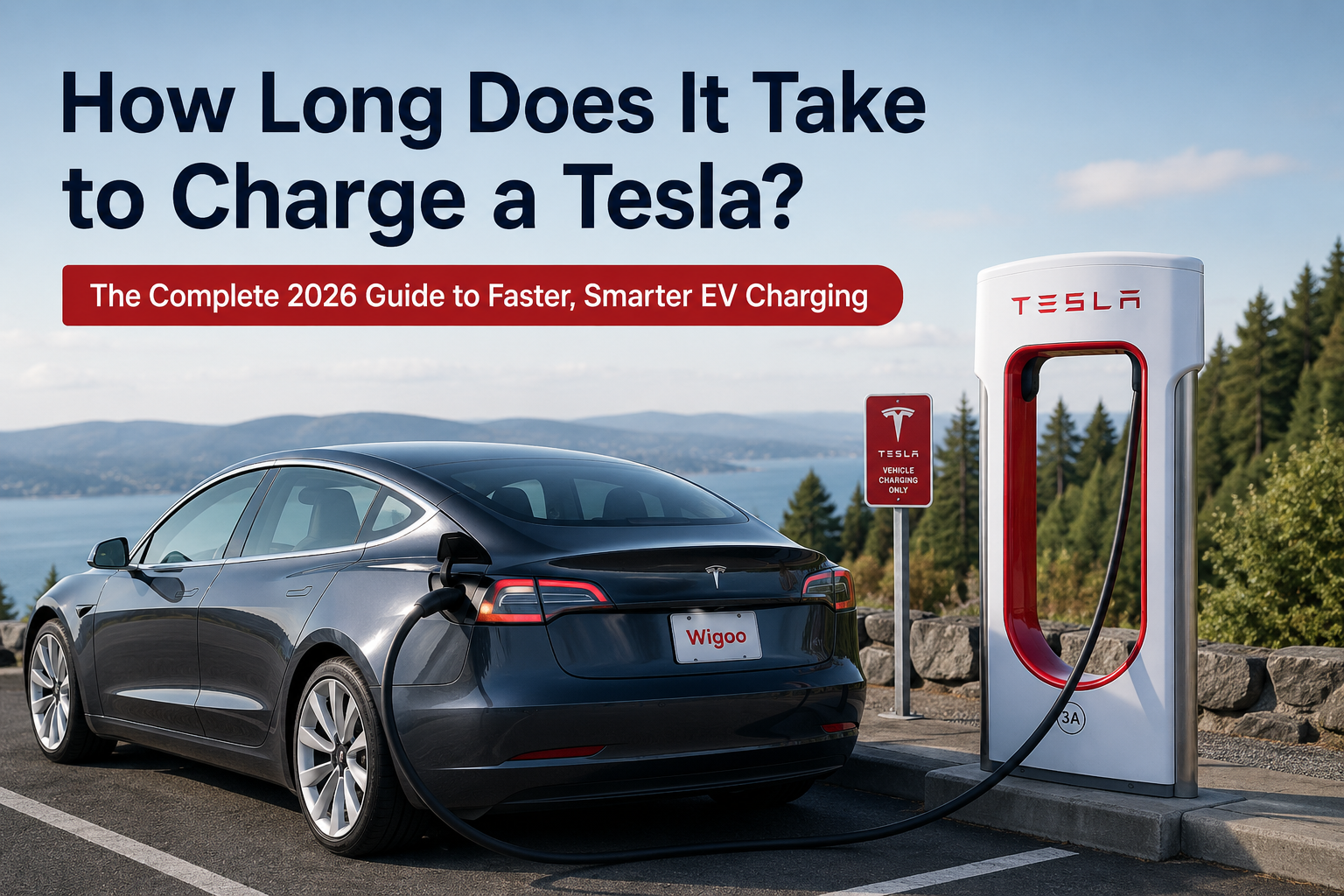
One of the first questions people ask before buying a Tesla is surprisingly simple:
"How long does it take to charge?"
The answer, however, isn't as straightforward as many online articles suggest.
You may have seen claims that a Tesla can charge in just 15 to 30 minutes. While technically true under ideal conditions, many owners quickly discover that their real charging sessions often take longer. The difference isn't caused by faulty chargers or inaccurate vehicle estimates—it's the result of how modern lithium-ion batteries are designed to protect themselves.
Understanding why charging speed changes throughout a session is just as important as knowing the charging times themselves. Once you understand the factors behind Tesla's charging system, you'll know exactly how to reduce charging time, improve road-trip efficiency, and extend battery life.
In this guide, we'll go beyond the advertised numbers and explain what Tesla owners actually experience in everyday driving.
Quick Answer: Tesla Charging Times at a Glance
Charging time depends primarily on four factors:
- The type of charger you're using
- Your battery's current state of charge
- Battery temperature
- Your Tesla model and battery size
Here's a quick overview of typical charging times.
| Charging Method | Typical Charging Time | Best For |
|---|---|---|
| Tesla Supercharger (250 kW) | 20–30 minutes (10%–80%) | Road trips |
| Tesla Supercharger (150 kW) | 25–40 minutes | Long-distance travel |
| Level 2 Home Charger (240V) | 6–10 hours | Overnight charging |
| Level 1 Household Outlet (120V) | 30–70 hours | Emergency charging |
| Destination Charger | 4–10 hours | Hotels, workplaces, shopping centers |
For most Tesla owners, home charging overnight is the most convenient option, while Superchargers are designed to minimize travel interruptions during longer journeys.
Why Two Tesla Owners Can Have Completely Different Charging Times
This is where many charging guides stop—but it's where the most useful information actually begins.
Imagine two drivers arriving at the exact same Supercharger.
Both drive identical Model Y vehicles.
Both plug into the same charging station.
One finishes charging in 23 minutes.
The other spends nearly 40 minutes.
What happened?
The answer lies in something many first-time EV owners don't realize:
A Tesla does not charge at one constant speed.
Instead, charging power changes continuously throughout the charging session.
Your vehicle's Battery Management System (BMS) constantly monitors hundreds of battery parameters—including temperature, voltage, internal resistance, and state of charge—to determine how much power the battery can safely accept.
Rather than charging at maximum speed from 0% to 100%, Tesla deliberately slows charging under certain conditions to protect long-term battery health.
This intelligent charging strategy is one of the reasons Tesla batteries can maintain impressive capacity even after hundreds of thousands of miles.
Understanding Tesla's Charging Curve
One of the biggest misconceptions about EV charging is the belief that a 250 kW Supercharger delivers 250 kW during the entire session.
In reality, that number represents the maximum peak charging power, not the average charging speed.
A typical charging session follows a curve similar to this:
- 0–20% battery: Charging ramps up rapidly.
- 20–50% battery: Charging reaches its highest power output.
- 50–80% battery: Power gradually decreases.
- 80–100% battery: Charging slows significantly to protect the battery.

This explains why adding the last 20% often takes nearly as long as charging from 20% to 80%.
For daily driving, many experienced Tesla owners choose to charge only to 80%, not because the car can't charge further, but because doing so saves time while reducing battery stress.
What Actually Determines Charging Speed?
Although charger power receives the most attention, it's only one piece of the puzzle.
Several variables work together to determine how quickly your Tesla can recharge.
1. Battery State of Charge
The lower the battery percentage when you arrive, the faster your vehicle can usually charge.
For example:
- 10% battery → very high charging speed
- 30% battery → near peak performance
- 60% battery → charging begins to taper
- Above 80% → charging slows considerably
This behavior is intentional and helps minimize heat generation while preserving battery longevity.
2. Battery Temperature
Temperature is one of the most influential—and least understood—factors affecting charging performance.
Lithium-ion batteries operate most efficiently within a specific temperature range.
If the battery is too cold, charging must be limited to avoid damage.
If it's too hot, charging is also reduced to prevent excessive heat buildup.
That's why a Tesla arriving at a Supercharger after sitting overnight in freezing weather may initially charge much slower than expected.
Fortunately, Tesla includes an intelligent feature called battery preconditioning.
When you navigate to a Supercharger using the vehicle's navigation system, your Tesla automatically warms or cools the battery before arrival, helping it reach the ideal charging temperature.
Many new owners are surprised by how much this feature improves charging speed—especially during winter.
3. Charger Output
Not all fast chargers deliver the same amount of power.
A 50 kW DC charger, a 150 kW Supercharger, and a 250 kW Supercharger can produce dramatically different charging times.
However, your Tesla can only accept as much power as both the charger and the vehicle's battery allow.
For example, connecting to a 350 kW public charger doesn't necessarily mean your Tesla will charge at 350 kW.
The vehicle automatically limits power based on its own charging capabilities and battery condition.
4. Tesla Model and Battery Size
Charging performance also varies between Tesla models.
Different vehicles use different battery capacities, cooling systems, charging software, and battery chemistries.
Generally speaking:
- Smaller battery packs may reach higher percentages more quickly.
- Larger battery packs take longer to fully recharge but often gain more driving range per minute when fast charging.
- Newer Tesla models include software improvements that optimize charging efficiency under a wider range of conditions.
Rather than focusing solely on battery size, it's more useful to think about usable driving range gained during each charging session.
After all, most drivers care less about battery percentage and more about how quickly they can get back on the road.
The Biggest Charging Myth
Many advertisements emphasize charging from 10% to 80% in around 25 minutes, leading some drivers to expect that charging from 80% to 100% should take only another six or seven minutes.
In reality, that's rarely the case.
The final portion of the charging session is intentionally much slower because the battery transitions from high-current charging to a carefully controlled constant-voltage phase.
This gradual reduction in charging power helps minimize internal battery stress, reduces heat generation, and contributes to the exceptional longevity for which Tesla batteries are known.
Understanding this charging behavior changes the way experienced owners plan road trips. Instead of waiting for a full battery at every stop, they often make shorter, more frequent charging stops, spending less total time waiting and more time driving.
In the next section, we'll compare every Tesla charging method in detail, explain which option is best for different lifestyles, and break down realistic charging times for every current Tesla model.
Every Tesla Charging Method Explained
Choosing the right charging method is just as important as knowing how long charging takes. While Tesla owners have access to several charging options, each one is designed for a different driving scenario.
Instead of asking, "Which charger is the fastest?" a better question is:
"Which charger best fits the way I drive?"
For most owners, the answer isn't the same every day. Home charging handles daily commuting, while DC fast charging keeps long road trips efficient. Understanding when to use each option helps you spend less time waiting and more time driving.
Tesla Superchargers: The Fastest Way to Recharge
Tesla's Supercharger network remains one of the biggest advantages of owning a Tesla. Unlike many third-party charging networks, Superchargers are fully integrated with Tesla's navigation system, battery management software, and route planning.
When you select a Supercharger as your destination, your Tesla doesn't simply guide you there—it prepares the battery before you arrive.
This process, called battery preconditioning, warms or cools the battery to its optimal charging temperature. A properly conditioned battery can often begin charging at significantly higher power than one that arrives cold.
This is why two identical Teslas using the same charger may experience very different charging speeds.
Typical Supercharger Charging Times
| Battery Level | Typical Time (V3/V4 Supercharger) |
|---|---|
| 10% → 50% | 10–15 minutes |
| 10% → 80% | 20–30 minutes |
| 20% → 80% | 18–25 minutes |
| 80% → 100% | 20–35 minutes |
Notice something surprising?
Charging from 80% to 100% can take almost as long as charging from 10% to 80%.
This isn't a limitation of the charger—it's a deliberate strategy to protect the battery from excessive heat and voltage stress.
Home Charging: The Charging Method You'll Use Most
Although Superchargers receive the most attention, experienced Tesla owners know that home charging is where EV ownership becomes truly convenient.
Instead of making dedicated trips to a gas station, your vehicle simply charges while you sleep.
For drivers who travel between 30 and 60 miles (50–100 km) per day, overnight charging easily replaces the energy used during normal commuting.
Level 2 Home Charging
A 240-volt home charger, such as the Tesla Wall Connector or another compatible Level 2 EV charger, is the preferred solution for most households.
Typical charging times are:
| Tesla Model | Approximate Full Charge |
|---|---|
| Model 3 RWD | 6–7 hours |
| Model 3 Long Range | 7–8 hours |
| Model Y | 7–9 hours |
| Model S | 8–10 hours |
| Model X | 8–10 hours |
| Cybertruck | 9–11 hours |
The exact time depends on battery capacity, charger output, and the maximum AC charging rate supported by your vehicle.

For many owners, these numbers are almost irrelevant in daily life.
Why?
Because the car is usually plugged in overnight. Whether charging finishes at 2:00 AM or 5:00 AM makes little practical difference if you leave for work at 8:00 AM.
Is Level 1 Charging Worth Using?
Every Tesla includes the ability to charge from a standard household outlet.
This method requires no additional installation, making it useful for emergencies or occasional charging.
However, it's also the slowest option.
Typical charging speed:
-
Around 2–5 miles (3–8 km) of range per hour
-
A full recharge may take more than two days
For drivers covering only short daily distances, Level 1 charging may be enough.
For everyone else, it's best viewed as a temporary solution rather than a long-term charging strategy.
Destination Charging
Destination chargers are Level 2 chargers installed at places where drivers naturally spend time, such as:
-
Hotels
-
Restaurants
-
Shopping centers
-
Office buildings
-
Tourist attractions
Rather than waiting specifically for your car to charge, the vehicle gains range while you're sleeping, working, or enjoying your destination.
This makes destination charging one of the most overlooked conveniences of EV ownership.
Charging Times by Tesla Model
Although charging technology is similar across Tesla's lineup, each model has different battery capacities and charging characteristics.
Tesla Model 3
The Model 3 is one of Tesla's most efficient vehicles.
Because it consumes relatively little energy per mile, every minute spent charging adds useful driving range quickly.
Typical Supercharger session:
-
10% → 80%: about 25 minutes
Typical overnight home charging:
-
6–8 hours
For many commuters, plugging in overnight once or twice per week is sufficient.
Tesla Model Y
As Tesla's best-selling vehicle worldwide, the Model Y balances practicality with excellent charging performance.
Its larger battery means charging takes slightly longer than a Model 3, but the difference is relatively small.
Typical charging times:
-
Supercharger: 25–30 minutes
-
Home charging: 7–9 hours
Because many families rely on the Model Y for road trips, charging efficiency becomes especially important during long-distance travel.
Tesla Model S
The Model S features a larger battery pack and longer driving range.
Although a complete charge naturally takes longer, it also gains substantial range during each minute connected to a Supercharger.
Typical charging:
-
Supercharger: 30 minutes (10–80%)
-
Home charging: 8–10 hours
Long-distance drivers often find that only one or two charging stops are needed during journeys that would require several fuel stops in a conventional vehicle.
Tesla Model X
The Model X combines SUV practicality with high performance.
Because of its weight and battery capacity, charging characteristics are similar to the Model S.
Typical charging:
-
Supercharger: around 30 minutes
-
Home charging: approximately 9 hours
Families traveling with children often discover that charging breaks naturally align with meal or restroom stops, making the additional charging time less noticeable than expected.
Tesla Cybertruck
The Cybertruck introduces new engineering approaches that improve charging efficiency while supporting its much larger battery.
Although battery size is greater than Tesla's passenger cars, DC fast charging still keeps long-distance travel practical.
Typical charging:
-
Supercharger: approximately 30–35 minutes
-
Home charging: overnight using a Level 2 charger
For owners using the Cybertruck for towing or outdoor adventures, charging stops are often planned alongside rest breaks or destination charging opportunities.
Why Cold Weather Makes Charging Slower
One of the most common concerns among new Tesla owners is slower charging during winter.
The outside temperature itself isn't the primary issue.
The real factor is battery temperature.
Lithium-ion batteries accept energy most efficiently within a relatively narrow temperature range.
When the battery is cold, internal resistance increases. To prevent damage, the Battery Management System limits charging power until the battery warms up.
This is why a Tesla parked outside overnight may initially charge much more slowly than expected.
Fortunately, Tesla automatically addresses this challenge.
Battery Preconditioning: Tesla's Hidden Advantage
Many first-time owners don't realize that Tesla is actively preparing the battery long before charging begins.
When you enter a Supercharger as your navigation destination, the vehicle automatically starts conditioning the battery during the drive.
This process can dramatically improve charging performance upon arrival.
To get the fastest possible charging speeds:
-
Always navigate to the Supercharger instead of simply driving there.
-
Allow enough driving time for the battery to reach its ideal temperature.
-
Avoid unplugging immediately after arrival if the vehicle indicates that battery conditioning is still in progress.
These small habits can noticeably reduce total charging time, especially in colder climates.
The Real Secret to Fast Road Trips
Many people assume that charging to 100% at every stop will get them to their destination faster.
In practice, the opposite is often true.
Experienced Tesla drivers usually stop charging once the battery reaches 70% to 80%, then continue driving to the next Supercharger.
Because the battery charges much faster at lower states of charge, two shorter charging sessions often take less total time than one long session to 100%.
Tesla's trip planner understands this principle and automatically recommends charging stops that minimize overall travel time rather than maximizing battery percentage.
For most long-distance journeys, trusting the vehicle's route planning produces faster and more efficient trips than trying to manually optimize every charging stop.
How to Charge Your Tesla Faster (Without Hurting the Battery)
Every Tesla owner wants shorter charging stops, but charging faster isn't about finding a more powerful charger—it's about helping your battery accept energy more efficiently.
The good news is that a few simple habits can noticeably reduce charging time without compromising battery health.
1. Arrive at a Supercharger with a Low Battery
Tesla batteries charge fastest when they're at a lower state of charge.
For road trips, arriving with around 10% to 20% battery usually results in the highest charging speeds.
If you stop to charge while your battery is already at 60% or 70%, the vehicle has less room to accept high charging power, meaning you'll spend more time waiting for comparatively fewer miles of added range.
2. Always Use Tesla Navigation
This is one of the easiest ways to improve charging performance—and one of the most overlooked.
Instead of driving directly to a Supercharger, enter it as your destination in the Tesla navigation system.
Doing so allows the vehicle to begin battery preconditioning, bringing the battery to its optimal temperature before you arrive.
Many owners notice significantly faster charging speeds simply by letting the car prepare itself during the drive.
3. Don't Wait for 100% During Road Trips
One of the biggest mindset shifts for new EV owners is realizing that charging to 100% isn't always the fastest way to travel.
Imagine two drivers taking the same 600-mile trip.
Driver A charges from 10% to 100% once.
Driver B charges from 10% to 75% twice.
Although Driver B makes an extra stop, they often reach their destination sooner because both charging sessions remain in the battery's fastest charging range.
This is exactly how Tesla's Trip Planner optimizes long-distance travel.
4. Charge Overnight at Home
If you have access to a Level 2 home charger, overnight charging eliminates almost all waiting.
Instead of thinking about "charging time," your car simply starts every morning with the battery level you selected.
For most owners, this completely changes the refueling experience compared with gasoline vehicles.
5. Avoid Repeated Fast Charging When It's Unnecessary
Superchargers are designed for frequent use, and occasional daily fast charging won't immediately harm your battery.
However, for routine commuting, slower AC charging at home generally produces less heat and places less stress on the battery over many years.
Whenever possible:
-
Use home charging for daily driving.
-
Reserve Superchargers for travel or when time matters.
This balance offers both convenience and long-term battery health.
Does Supercharging Damage the Battery?
It's one of the most common questions among prospective Tesla buyers.
The short answer is:
Not nearly as much as many people think.
Tesla's battery management software continuously regulates charging speed, temperature, and voltage to reduce degradation.
Multiple long-term ownership studies have shown that Tesla batteries typically retain a high percentage of their original capacity even after hundreds of thousands of miles.
The more significant factors affecting battery health are often:
-
Keeping the battery at 100% for extended periods
-
Frequently allowing the battery to remain completely empty
-
Repeated exposure to extreme heat
-
Long-term storage without proper charge levels
Fast charging itself is only one small part of the overall picture.
Daily Charging Best Practices
Charging habits should match how you actually use your vehicle.
For Daily Commuting
If you mainly drive to work, run errands, or take short trips:
-
Charge at home whenever possible.
-
Set your daily charging limit to around 80% (or follow Tesla's recommended limit for your specific battery chemistry).
-
Plug in overnight rather than waiting until the battery becomes very low.
This routine minimizes effort while supporting long-term battery performance.
For Long Road Trips
When traveling hundreds of miles in a single day:
-
Let Tesla plan your charging stops.
-
Arrive at Superchargers with a relatively low battery.
-
Leave once you've gained enough energy to comfortably reach the next charger.
Waiting for a full battery at every stop usually adds unnecessary travel time.
Common Tesla Charging Mistakes
Even experienced EV drivers occasionally develop habits that reduce charging efficiency.
Here are some of the most common mistakes.
Charging to 100% Every Day
Unless your trip requires maximum range, charging to full capacity every night generally provides little practical benefit.
For most daily driving, keeping the battery below full charge helps reduce long-term battery stress.
Ignoring Battery Preconditioning
Driving straight to a Supercharger without navigation may prevent the vehicle from preparing the battery.
Especially during cold weather, this can noticeably reduce charging speed.
Assuming Every Public Charger Is Fast
Not all charging stations offer the same power output.
Two chargers may look nearly identical while delivering dramatically different charging speeds.
Whenever possible, check charger power ratings before plugging in.
Waiting Until the Battery Is Completely Empty
Although Tesla batteries include protective systems, regularly reaching extremely low battery levels isn't necessary.
Keeping a comfortable energy reserve also provides more flexibility for unexpected detours or traffic.
Focusing Only on Battery Percentage
Many drivers watch the battery percentage instead of considering usable driving range.
During a road trip, gaining enough range to comfortably reach your destination is far more important than reaching an arbitrary percentage.
How Much Does It Cost to Charge a Tesla?
Charging costs vary depending on electricity prices, charging location, and local utility rates.
In general:
| Charging Method | Typical Cost |
|---|---|
| Home Charging | Lowest overall cost |
| Workplace Charging | Often free or discounted |
| Destination Charging | Frequently complimentary for guests |
| Tesla Supercharger | Higher than home charging but usually less expensive than gasoline for similar driving distances |
Because electricity prices differ between regions, the exact savings depend on where you live.
Many utility providers also offer lower overnight electricity rates, making home charging even more economical.
Frequently Asked Questions
Is it OK to leave my Tesla plugged in overnight?
Yes.
Tesla recommends keeping the vehicle plugged in whenever it's convenient. The charging system automatically manages battery levels based on your selected charge limit.
Should I charge to 100% every day?
For most owners, no.
Daily charging to around 80% is sufficient for typical commuting, unless Tesla specifically recommends otherwise for your battery type or you need maximum range for an upcoming trip.
Why does charging slow down after 80%?
As battery voltage increases, the Battery Management System gradually reduces charging power to minimize heat generation and protect long-term battery health.
Can I use a public DC fast charger that isn't a Tesla Supercharger?
Yes.
Depending on your vehicle model and region, Teslas can charge at many compatible public DC fast charging networks using the appropriate connector or adapter.
How often should I Supercharge?
As often as necessary.
Tesla vehicles are engineered for frequent fast charging, but if convenient home charging is available, it remains the preferred option for everyday use.
Will cold weather permanently reduce my charging speed?
No.
Cold temperatures temporarily slow charging because the battery must first warm to an efficient operating range.
Once properly conditioned, charging performance returns to normal.
Final Thoughts
Charging a Tesla is very different from refueling a gasoline vehicle—not because it takes longer, but because it becomes part of your daily routine rather than a dedicated stop.
For most owners, the majority of charging happens quietly at home while they sleep. On longer journeys, Tesla's Supercharger network and intelligent route planning minimize downtime by recommending charging stops that balance speed with efficiency.
Perhaps the most valuable lesson for new owners is this:
The fastest charging session isn't always the one that reaches 100%.
Understanding how battery temperature, state of charge, and charging curves interact allows you to spend less time waiting, protect your battery over the long term, and enjoy a smoother ownership experience.
As Tesla continues to improve battery technology, charging infrastructure, and software optimization, charging will only become faster and more seamless. Learning the fundamentals today will help you get the most from your Tesla for years to come.


Comments
Post a Comment