Tesla's AI Ceiling: Why Better Engineering Matters More Than Bigger AI Models
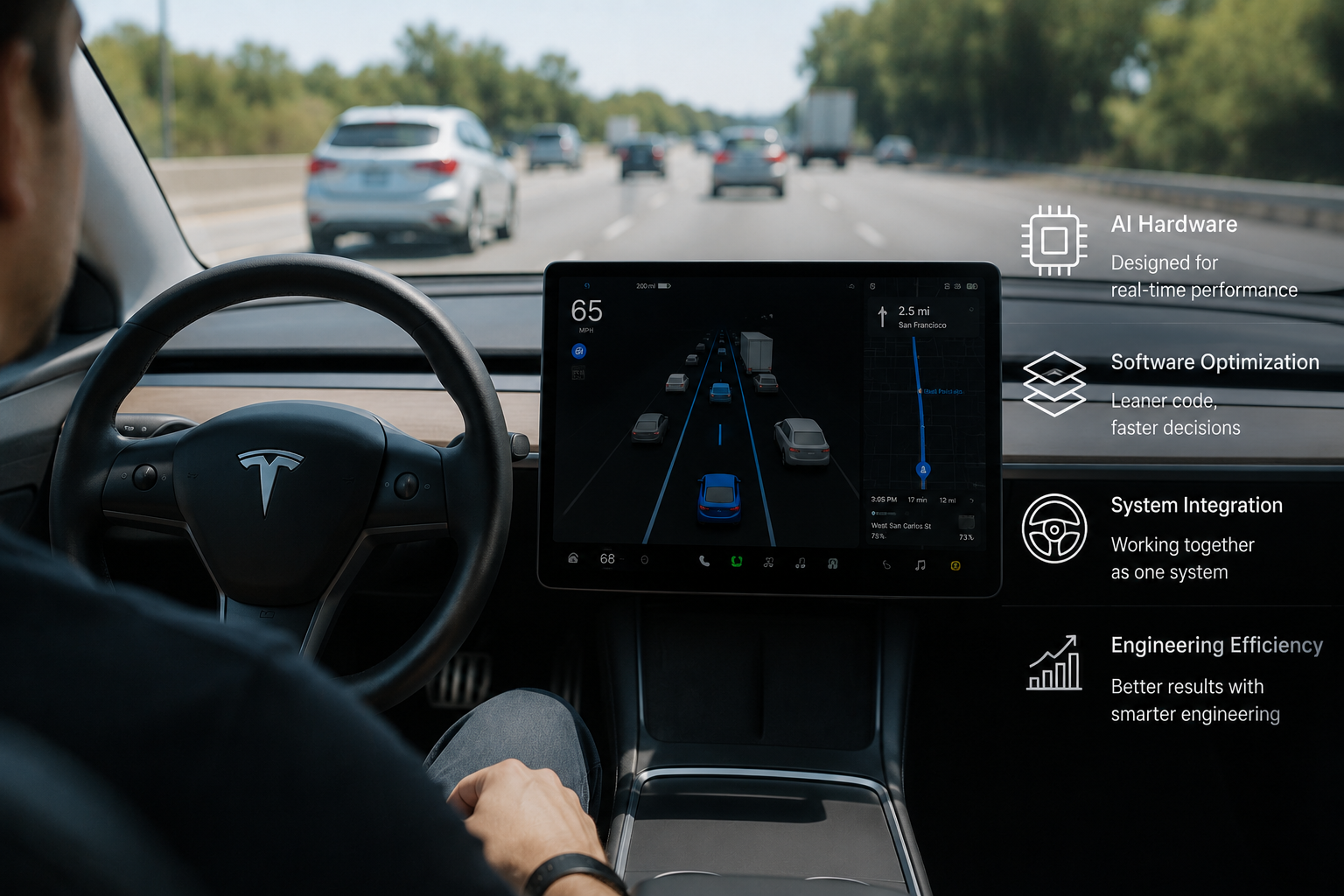
Bigger AI Doesn't Always Mean Better Self-Driving
Artificial intelligence has entered an era where larger models often attract the most attention.
Every few months, a new AI system claims more parameters, greater computing power, or improved reasoning capabilities.
It's easy to assume that autonomous driving follows the same path:
Build a larger AI model, add more computing power, and self-driving automatically becomes better.
The reality is far more complex.
Unlike a conversational AI that has several seconds to generate a response, a vehicle traveling at highway speeds has only fractions of a second to perceive its surroundings, interpret the situation, decide on an action, and execute that decision safely.
Every millisecond matters.
That is why Tesla's future in autonomous driving depends not only on stronger AI models, but on the efficiency of the entire engineering system supporting them.
Autonomous Driving Is an Engineering Problem Before It's an AI Problem
Many people describe Full Self-Driving as an artificial intelligence challenge.
That is true—but only partially.
A self-driving vehicle is one of the most demanding real-time computing systems ever deployed to consumers.
Before the AI can make a decision, a complex chain of events must happen almost instantly.
The vehicle must:
- Capture video from multiple cameras.
- Process enormous amounts of visual information.
- Detect vehicles, pedestrians, cyclists, and road signs.
- Predict how surrounding traffic may behave.
- Plan the safest driving path.
- Control steering, braking, and acceleration.
Each step depends on the one before it.
If any stage introduces unnecessary delay, the quality of the entire system suffers.
This means autonomous driving is not simply about building smarter AI.
It is about ensuring that every component—from sensors to software—works together with exceptional speed and reliability.
Why More Computing Power Has Limits
Modern AI models thrive on computational resources.
More GPUs.
More memory.
More parameters.
More training data.
For cloud-based applications, scaling up hardware often produces measurable improvements.
Vehicles operate under very different constraints.
A car cannot simply install another server rack when a larger AI model becomes available.
Everything must fit within strict limits for:
- Electrical power consumption
- Heat generation
- Physical space
- Weight
- Cost
- Long-term reliability
Increasing model size without considering these constraints can actually reduce overall system performance.
A larger neural network may require more memory, consume more energy, and introduce additional processing delay.
In autonomous driving, even small increases in latency can affect how quickly a vehicle reacts to changing road conditions.
The fastest model is not necessarily the safest model.
The most effective system is often the one that balances intelligence with efficiency.
Latency Matters More Than Most People Realize
When discussing AI performance, headlines usually focus on accuracy.
For self-driving vehicles, another metric is equally important:
Latency.
Latency measures how long it takes for the system to respond after receiving new information.
Imagine a vehicle traveling at 100 km/h.
It covers nearly 28 meters every second.
A delay of just 100 milliseconds means the vehicle has already moved almost three meters before acting.
That distance can be the difference between a comfortable lane adjustment and an emergency maneuver.
This is why Tesla invests heavily in reducing the time required for every stage of the decision-making process.
Faster processing doesn't merely improve convenience.
It directly contributes to safety.
AI Alone Cannot Solve Real-World Driving
One common misconception is that once an AI becomes "smart enough," autonomous driving will naturally be solved.
In practice, intelligence alone is insufficient.
An AI model may correctly recognize a pedestrian.
However, the complete system must also determine:
- Whether the pedestrian intends to cross.
- How nearby vehicles are behaving.
- Whether braking or steering is the safer response.
- How road conditions affect stopping distance.
- Whether another obstacle exists outside the camera's immediate view.
These decisions require more than object recognition.
They require continuous interaction between perception, prediction, planning, and control.
Engineering these interactions is often more challenging than improving the AI model itself.
Tesla's Advantage Comes From Optimizing the Entire Stack
Unlike many automotive manufacturers, Tesla develops much of its technology in-house.
This includes:
- Camera hardware
- AI chips
- Vehicle operating software
- Neural network training
- Power management
- Thermal systems
- Vehicle controls
- Manufacturing processes
Each layer influences the next.
Optimizing only one component rarely produces the best result.
Instead, Tesla focuses on improving the complete technology stack.
For example, a more efficient AI compiler can reduce processing time without requiring a larger processor.
A redesigned thermal system can maintain higher computing performance during demanding workloads.
Better memory management can allow the same hardware to execute more sophisticated neural networks.
These engineering improvements often deliver greater real-world benefits than simply increasing model size.
Bigger Models Are Not Always Smarter Models
Recent advances in generative AI have encouraged the belief that larger models consistently outperform smaller ones.
For language models, that trend is often true.
Autonomous driving presents different priorities.
A vehicle does not need to answer philosophical questions or write essays.
It needs to make safe driving decisions continuously under strict timing constraints.
An autonomous driving system therefore seeks a different balance.
Instead of maximizing model size, engineers aim to maximize:
- Decision quality
- Response speed
- Energy efficiency
- Reliability
- Hardware utilization
In many cases, a carefully optimized medium-sized model can outperform a significantly larger one when deployed inside a real vehicle.
This principle explains why engineering efficiency has become just as important as AI capability.
Engineering Efficiency Is Becoming Tesla's Real Competitive Advantage
When people compare AI companies, they often ask:
Who has the biggest model?
Tesla approaches the question differently.
Instead of asking how large an AI model can become, Tesla increasingly asks:
How efficiently can AI solve a real-world problem?
That distinction defines much of Tesla's engineering philosophy.
For an autonomous vehicle, intelligence alone has little value if the system cannot respond quickly, reliably, and consistently under every driving condition.
A slightly smaller model that delivers faster, more predictable decisions may outperform a much larger model that introduces additional processing delays.
In autonomous driving, efficiency is not a compromise—it is a performance advantage.
Why Tesla Renamed "FSD Computer" to "AI Computer"
Recent software updates quietly replaced the term FSD Computer with AI Computer.
Although Tesla has not publicly explained the reasoning behind this change, the broader wording reflects an important shift in perspective.
A "Full Self-Driving Computer" suggests hardware designed for a single application.
An "AI Computer" implies something much broader.
It can support:
- Autonomous driving
- Vehicle perception
- Driver monitoring
- Predictive energy management
- Manufacturing automation
- Future AI-powered services
In other words, Tesla is gradually positioning artificial intelligence as the common foundation across its products rather than treating self-driving as a standalone feature.
The terminology may seem minor, but it aligns with Tesla's growing emphasis on AI throughout its business.
Dojo Isn't About Building the Biggest AI Model
One of the most common misunderstandings surrounding Tesla's Dojo supercomputer is that it exists simply to train larger neural networks.
In reality, its purpose is far more practical.
Autonomous driving generates an enormous volume of video data every day.
Millions of Tesla vehicles continuously encounter different road layouts, weather conditions, traffic behaviors, and rare driving events.
Processing this information efficiently is a massive engineering challenge.
Dojo is designed to accelerate that process.
Its value lies in helping Tesla:
- Train models faster.
- Process larger video datasets.
- Reduce training costs.
- Shorten development cycles.
- Iterate AI improvements more frequently.
The goal is not necessarily to create the largest possible model.
Instead, Tesla aims to improve the speed and efficiency with which new driving intelligence can be developed and deployed.
The Fastest Learning System Often Wins
Artificial intelligence improves through repetition.
Every training cycle teaches the model something new.
If one company can complete five training iterations while another completes only one during the same period, the faster learner may ultimately gain a greater advantage.
This is why engineering efficiency matters beyond the vehicle itself.
Reducing the time required to:
- Collect data,
- Label scenarios,
- Train neural networks,
- Validate performance,
- Deploy updates,
creates a faster feedback loop.
That continuous cycle enables Tesla to refine its driving software more frequently than traditional automotive development processes, where major improvements are often tied to new vehicle generations.
Vertical Integration Multiplies AI Performance
Tesla's engineering strategy differs from many competitors because it controls much of the technology stack internally.
Rather than sourcing every major component from different suppliers, Tesla develops many critical systems itself.
These include:
- Camera systems
- AI hardware
- Vehicle operating software
- Battery management
- Thermal control
- Power electronics
- Neural network training infrastructure
This level of integration offers an important advantage.
Changes made in one part of the system can be optimized alongside every other layer.
For example:
A more efficient neural network may reduce processor workload.
Lower processor workload generates less heat.
Reduced heat allows sustained computing performance.
Higher sustained performance enables more consistent driving behavior.
Each improvement amplifies the next.
This is why Tesla often describes its technology as an integrated platform rather than a collection of independent components.
Bigger Models Also Consume More Energy
One reality often overlooked in discussions about AI is energy consumption.
Every additional parameter requires computation.
More computation increases:
- Power usage
- Heat generation
- Memory bandwidth
- Cooling requirements
Inside a cloud data center, these costs can be addressed by adding more servers or upgrading cooling systems.
Inside a vehicle, those options are far more limited.
Every watt consumed by onboard computing ultimately comes from the vehicle's battery.
Higher computing demands may reduce energy efficiency or require more sophisticated thermal management.
As a result, Tesla engineers must balance intelligence with practical operating constraints.
An autonomous driving system must be not only capable but also efficient enough to function reliably during years of daily use.
Why Reliability Matters More Than Peak Performance
Artificial intelligence demonstrations often showcase ideal conditions.
Clear weather.
Simple roads.
Predictable traffic.
Real-world driving rarely offers such consistency.
A self-driving system must operate reliably through:
- Heavy rain.
- Bright sunlight.
- Snow.
- Fog.
- Construction zones.
- Unexpected driver behavior.
- Damaged road markings.
This is where engineering discipline becomes just as important as AI capability.
A system that performs exceptionally well 95% of the time may still be unsuitable if the remaining 5% includes unpredictable failures.
Tesla therefore invests heavily in reducing edge-case errors through continual software refinement and large-scale real-world data collection.
Reliability, rather than spectacular demonstrations, ultimately determines whether autonomous driving can earn public trust.
AI Success Depends on the Entire Pipeline
When people hear the term "artificial intelligence," they often picture a single neural network making decisions.
In reality, autonomous driving depends on an entire pipeline working together seamlessly.
That pipeline includes:
- High-quality sensor input.
- Efficient data transmission.
- AI inference.
- Motion prediction.
- Path planning.
- Vehicle control.
- Continuous system monitoring.
Improving only one stage rarely transforms the entire experience.
Tesla's engineering philosophy focuses on optimizing every link in the chain rather than relying on a single breakthrough.
This systems-level approach explains why many of Tesla's software updates introduce dozens of small refinements instead of one dramatic feature.
Each incremental improvement strengthens the overall platform.
The Real Meaning of an "AI Ceiling"
When people hear the phrase "AI ceiling," they often imagine that artificial intelligence has reached its maximum potential.
That isn't what engineers usually mean.
An AI ceiling is rarely about the model itself.
Instead, it describes the point where simply increasing model size produces diminishing real-world returns.
Imagine doubling the number of parameters in a neural network.
The model might become slightly more accurate during laboratory testing.
But if it also:
- Takes longer to process each frame,
- Consumes significantly more power,
- Generates more heat,
- Requires more expensive hardware,
- Reduces reliability,
then the overall system may actually become less practical.
In engineering, success is measured by the performance of the complete system—not by the performance of one component in isolation.
For Tesla, the challenge is no longer just making AI smarter.
It is making intelligence scalable, efficient, and dependable inside millions of production vehicles.
Why Autonomous Driving Is a Systems Engineering Challenge
Many discussions about autonomous driving focus on neural networks.
Yet the neural network is only one part of a much larger machine.
Consider what happens every second while a Tesla is driving.
Multiple cameras capture high-resolution video.
Specialized processors decode that information.
Neural networks identify lanes, vehicles, cyclists, pedestrians, and traffic signals.
Prediction models estimate how nearby road users may behave.
Planning algorithms evaluate thousands of possible paths.
Finally, the vehicle converts those calculations into steering, braking, and acceleration commands.
Every stage must happen within fractions of a second.
If one link slows down, the entire system slows down.
This is why Tesla's engineering teams optimize the entire pipeline instead of focusing exclusively on AI model size.
Why Tesla Prioritizes Real-World Data Over Laboratory Benchmarks
Artificial intelligence performs exceptionally well in controlled testing environments.
Roads are different.
Every day, Tesla vehicles encounter situations that engineers could never fully anticipate.
Examples include:
- Temporary lane markings.
- Flashing construction signs.
- Unusual weather conditions.
- Emergency vehicles.
- Animals crossing unexpectedly.
- Drivers making illegal turns.
These "edge cases" rarely appear in benchmark datasets.
However, they define the difference between an impressive AI demonstration and a trustworthy autonomous driving system.
Tesla's advantage comes from collecting vast amounts of real-world driving data from its global fleet.
Each unusual situation becomes another opportunity to improve future software releases.
Rather than optimizing solely for benchmark scores, Tesla focuses on preparing its AI for the unpredictability of everyday driving.
Hardware and Software Must Evolve Together
One lesson repeated throughout the technology industry is that hardware and software achieve their best results when they are designed together.
Smartphones offer a familiar example.
Companies that control both the hardware and operating system can often deliver smoother performance than devices with more powerful specifications but less integration.
Tesla follows a similar philosophy.
Its engineers develop:
- Custom AI hardware.
- Vehicle operating software.
- Neural network architectures.
- Power management systems.
- Thermal solutions.
- Training infrastructure.
Because these components are designed as a unified platform, improvements in one area frequently enhance performance elsewhere.
A more efficient compiler can reduce processing time.
Lower processing demands generate less heat.
Reduced heat allows sustained peak performance.
Higher sustained performance supports more responsive autonomous driving.
This interconnected approach explains why Tesla often emphasizes engineering optimization rather than headline hardware specifications.
Why Incremental Improvements Often Beat Revolutionary Changes
Consumers naturally notice dramatic product launches.
Engineering teams often celebrate something different:
Small improvements repeated thousands of times.
A steering adjustment that feels slightly smoother.
A braking decision that appears more natural.
A lane change completed with greater confidence.
A navigation system that chooses a better stopping location.
Individually, these changes may seem insignificant.
Collectively, they transform the ownership experience.
Tesla's software philosophy reflects this mindset.
Rather than waiting several years to introduce one massive leap forward, the company continuously delivers incremental refinements through over-the-air updates.
Each release builds upon millions of miles of driving experience gathered from the global fleet.
Over time, these cumulative improvements can produce far greater progress than isolated breakthroughs.
The Future of AI Will Be Measured by Efficiency
For much of the recent AI boom, success was often associated with larger models, bigger data centers, and greater computational resources.
The next stage of AI development may emphasize something different:
Efficiency.
Future leaders in intelligent systems are unlikely to be determined solely by who trains the largest neural network.
Instead, they may be defined by who can deliver the greatest intelligence within practical constraints.
For autonomous vehicles, those constraints include:
- Real-time decision-making.
- Energy consumption.
- Thermal efficiency.
- Manufacturing cost.
- Reliability.
- Safety.
- Scalability.
Tesla's engineering direction increasingly reflects this reality.
The company appears focused on extracting more capability from every watt, every processor cycle, and every software update rather than relying exclusively on ever-larger AI models.
Frequently Asked Questions
What does the term "AI ceiling" mean?
An AI ceiling refers to the point where increasing model size or computing power produces progressively smaller real-world benefits. Beyond that point, engineering optimization often delivers greater improvements than simply adding more parameters.
Why can't Tesla just use a much larger AI model?
Autonomous vehicles operate under strict constraints involving processing speed, power consumption, heat, cost, and reliability. Larger models may improve certain benchmark metrics while reducing overall system efficiency.
Does Dojo make Full Self-Driving smarter?
Indirectly, yes.
Dojo is designed to accelerate AI training by processing enormous amounts of driving video more efficiently. Faster training allows Tesla to iterate and improve its neural networks more quickly, but Dojo itself is not installed inside customer vehicles.
Why is latency so important in autonomous driving?
Latency measures how quickly a system responds after receiving new information.
At highway speeds, even a delay of a few hundred milliseconds can translate into several additional meters of travel before the vehicle reacts, making low latency essential for both safety and driving quality.
Is bigger AI always better?
Not necessarily.
For autonomous driving, the most effective system balances intelligence, speed, efficiency, reliability, and energy consumption. A well-optimized model can outperform a significantly larger one if it makes faster and more consistent decisions in real-world conditions.
Final Thoughts
Tesla's AI journey demonstrates an important lesson that extends far beyond autonomous driving.
Artificial intelligence is no longer measured solely by the size of its models or the power of its hardware.
Its true value lies in how effectively it solves real-world problems.
For self-driving vehicles, intelligence must be delivered within strict limits of time, energy, and reliability.
That is why Tesla increasingly emphasizes engineering discipline alongside AI innovation.
Every improvement to hardware, software, compilers, thermal management, and training infrastructure contributes to the overall capability of the system.
Seen from this perspective, the future of autonomous driving is not simply a race to build the largest neural network.
It is a race to build the most efficient, dependable, and scalable intelligent platform.
Tesla's recent direction—from custom AI hardware and Dojo to continuous over-the-air updates—suggests the company understands that sustainable progress comes from optimizing the entire technology stack.
In the years ahead, the companies that lead autonomous driving may not be those with the biggest AI models.
They will likely be those that best integrate artificial intelligence, engineering, and real-world deployment into a seamless, continuously improving system.
Key Takeaways
- Bigger AI models do not automatically produce better autonomous driving performance.
- Engineering efficiency—including latency, power management, thermal design, and software optimization—is just as important as AI capability.
- Tesla's vertically integrated technology stack allows hardware, software, and AI to evolve together.
- Dojo accelerates AI training and development rather than simply enabling larger models.
- The future of autonomous driving will depend on delivering intelligent, reliable, and efficient systems at scale—not just increasing computational power.


Comments
Post a Comment